
Regenerative Treatment for Peyronie’s Disease:
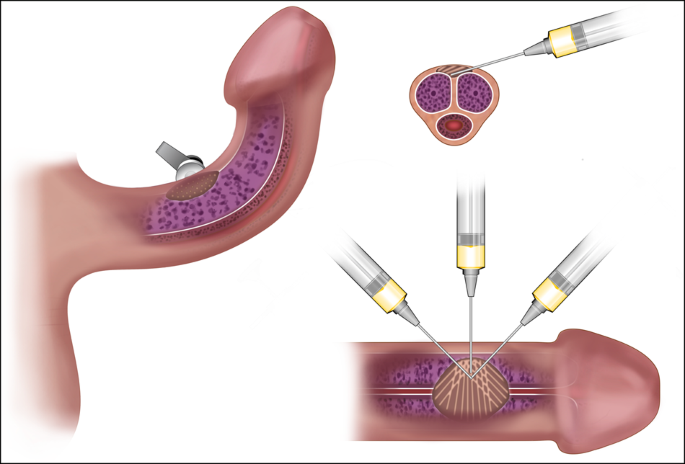
PRP with Plaque Needling
A detailed look at how PRP combined with physician-guided plaque needling works — the science, the technique, and why it’s one of the most promising non-surgical options for Peyronie’s disease.
“The combination of plaque needling with PRP tackles Peyronie’s at the source — physically disrupting the fibrous plaque while delivering the growth factors the body needs to remodel it.”
The Problem with Peyronie’s Plaque
Peyronie’s disease is driven by the development of fibrous scar tissue (plaque) within the tunica albuginea — the elastic sheath that surrounds the erectile chambers of the penis. This plaque is dense, inelastic, and restricts normal expansion during erections, causing curvature, pain, loss of length or girth, and often erectile dysfunction.
The challenge for any treatment is reaching the plaque effectively. Oral medications have limited penetration. FDA-approved Xiaflex (collagenase) injections target the plaque but have limitations. Surgery removes or compensates for the plaque but is invasive. This is where regenerative approaches become compelling.
The Two-Part Approach
PRP combined with plaque needling tackles Peyronie’s with a synergistic two-part strategy:
A physician-guided technique that creates micro-channels through the dense plaque. These small punctures disrupt the organized fibrous tissue, trigger a localized healing cascade, and open pathways for therapeutic agents to reach the plaque interior.
Platelet-rich plasma, prepared from a small sample of your own blood, is injected directly into and around the plaque. PRP contains concentrated growth factors that support collagen remodeling, improved blood flow, and tissue regeneration.
How PRP Actually Works
PRP contains concentrated platelets, which release growth factors — biologically active proteins that direct tissue repair. The key players include:
- PDGF (Platelet-Derived Growth Factor) — stimulates connective tissue cell proliferation
- TGF-β (Transforming Growth Factor Beta) — plays a central role in collagen remodeling
- VEGF (Vascular Endothelial Growth Factor) — supports formation of new blood vessels
- EGF (Epidermal Growth Factor) — promotes healthy cell growth and tissue regeneration
When PRP is delivered to the plaque area after needling, these growth factors interact with the disrupted scar tissue and surrounding healthy tissue. The goal is to shift the balance from pathological scarring toward more normal tissue remodeling.
Needling alone disrupts the plaque. PRP alone delivers growth factors. Together, they target the plaque more effectively — opening pathways and flooding them with the body’s own regenerative signals.
The Patient Experience
What to Expect at Each Session
The procedure is performed in-office and typically takes less than an hour:
- Numbing: Topical anesthetic cream is applied. Pronox (nitrous oxide) is available for additional comfort.
- PRP preparation: A small sample of your blood is drawn and processed to concentrate the platelets.
- Plaque needling: Dr. Gabal uses a physician-guided technique to create micro-channels through the plaque.
- PRP injection: Concentrated PRP is injected into and around the needled area.
- Recovery: Most patients return to normal activities the same day. Mild bruising or swelling is possible.
Treatment Timeline
Peyronie’s treatment is a process, not a one-time fix. Dr. Gabal develops an individualized treatment plan based on your anatomy, severity of curvature, and response to initial sessions. Many patients benefit from a series of treatments spaced several weeks apart, with follow-up evaluations to assess changes.
Response varies by individual, phase of disease (active vs. stable), and severity. Men with earlier, less fibrotic plaque often respond more favorably than those with severe long-standing calcified plaque.
Combining with Other Treatments
At PMG, Dr. Gabal may recommend combining PRP + plaque needling with other treatments to maximize results:
- ShockWave Therapy — Low-intensity shockwaves can further support tissue remodeling and blood flow, particularly for men also experiencing erectile dysfunction.
- Traction therapy (RestoreX or AndroDEEP) — Daily traction between PRP sessions may help with length preservation and tissue remodeling.
- Penile modeling — Manual modeling techniques may be incorporated at Dr. Gabal’s discretion.
The right combination is determined at your consultation based on your specific anatomy, severity, and treatment goals.
Is This Treatment Right for You?
This regenerative approach may be well-suited for men who:
- Have stable or early-stage Peyronie’s disease
- Are seeking a non-surgical alternative to plication or implants
- Haven’t had success with other treatments or wish to try regenerative options first
- Also experience erectile dysfunction and may benefit from combined treatment
- Want to preserve natural anatomy and avoid synthetic fillers
A consultation and ultrasound evaluation are required to determine candidacy and develop your individualized treatment plan.
Frequently Asked Questions
Plaque needling is a physician-guided technique that creates micro-channels through the fibrous plaque. This disrupts the dense scar tissue and triggers a localized healing response, allowing better integration of regenerative therapy. It’s performed in-office under topical numbing.
PRP (platelet-rich plasma) is prepared from your own blood and contains concentrated growth factors (PDGF, TGF-β, VEGF, EGF). When injected into and around the plaque, PRP supports collagen remodeling, improved blood flow, and tissue regeneration — potentially softening the plaque over time.
The two techniques work synergistically. Plaque needling physically disrupts the dense scar tissue and opens pathways for healing. PRP then delivers growth factors directly to the disrupted area, supporting the body’s natural remodeling process. Together they target the plaque more effectively than either alone.
Topical numbing cream is applied before the procedure. Pronox (nitrous oxide) is available for additional comfort. Most patients tolerate the treatment well with only mild discomfort.
Treatment plans are individualized. Many patients benefit from a series of treatments spaced several weeks apart. Dr. Gabal will develop a personalized plan based on your anatomy, curvature severity, and response.
Yes. Dr. Gabal often recommends combining this approach with ShockWave Therapy, traction therapy, or other complementary treatments for enhanced results — particularly for men who also have erectile dysfunction.
Little to no downtime. Most patients return to normal activities the same day. Some mild bruising or swelling is possible.
Learn If This Approach Is Right for You
Schedule a confidential consultation with Dr. Lamia Gabal to discuss PRP with plaque needling, review your ultrasound findings, and develop a personalized treatment plan.