
A minimally invasive BPH treatment
Prostate Artery Embolization (PAE) is a same-day outpatient procedure that gently reduces blood flow to the prostate, causing it to shrink over time. The result: relief from BPH urinary symptoms — without major surgery, with little discomfort, and with recovery measured in days, not weeks.
A targeted BPH treatment
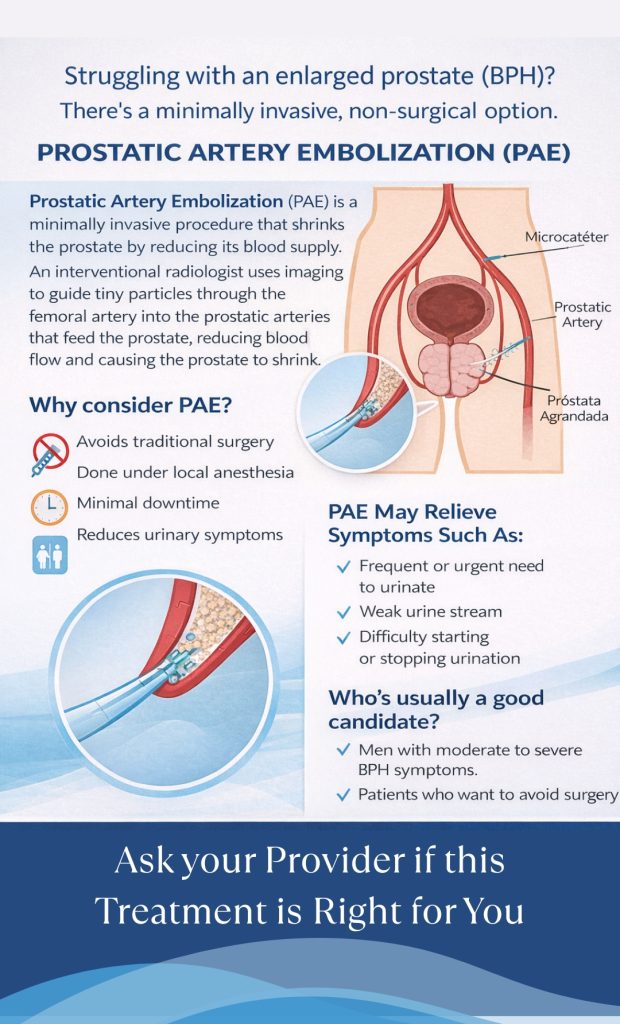
PAE is an outpatient procedure that typically takes one to two hours, is minimally invasive, and causes little discomfort. The procedure works by gently blocking the small arteries that supply blood to the prostate.
With less blood flow, the prostate gradually shrinks over time — relieving pressure on the urethra and improving urinary symptoms associated with benign prostatic hyperplasia (BPH). All in a single, same-day treatment.
Unlike surgical BPH treatments, PAE doesn’t require general anesthesia or any incisions. The entire procedure is performed through a single tiny catheter inserted into an artery in the wrist or upper thigh.
Performed by an experienced interventional radiologist
PAE is a specialized procedure performed by an experienced interventional radiologist — a physician trained in image-guided, catheter-based treatments. The interventional radiologist works closely with our urology team at Prestige Medical Group to coordinate care before, during, and after the procedure.
This collaborative model brings together urologic expertise in evaluation and follow-up with the specialized procedural skills required to safely place the embolization catheter and target the prostate arteries precisely.
The PAE procedure
The procedure uses image guidance to precisely target the small arteries supplying the prostate, allowing the gland to gradually shrink.
Four image-guided steps
The entire procedure is performed through a single tiny catheter — about 1 to 2 mm in size — inserted into a vessel in the wrist or upper thigh. Nothing is cut, and there are no significant incisions to heal.
A small 1–2 mm catheter is gently placed into an artery in the wrist or upper thigh.
Using ultrasound and X-ray guidance, the catheter is advanced to the arteries supplying the prostate.
Microscopic particles are injected to block the targeted vessels supplying the prostate.
Over the following weeks and months, reduced blood flow causes the prostate to gradually shrink.
The essentials
Minimally invasive
No major incisions or open surgery
1–2 hours
Typical procedure time
Outpatient
Same-day discharge for most patients
Little discomfort
Most patients tolerate it well
PAE may be right for you if…
You have benign prostatic hyperplasia (BPH) confirmed by imaging or diagnostic evaluation
You experience moderate to severe urinary symptoms affecting your quality of life
Your symptoms are not adequately managed with medications, or you’re experiencing medication side effects
You’re seeking a minimally invasive alternative to surgery, or you’re not a candidate for surgical procedures
Results & recovery
Most patients tolerate PAE well, with minimal recovery time and gradual but meaningful symptom improvement over the following months.
Most patients go home the same day and resume light activity within 24 hours.
Symptom improvement is often noticed within weeks, with continued relief over several months.
Studies show significant reductions in prostate size and better urine flow for most patients following PAE.
Side effects are rare and mild, such as temporary pelvic discomfort or urinary frequency.
PAE in the context of BPH care
PAE is one of several treatment options for BPH. Your urology team will help you understand which option is best suited to your prostate size, symptoms, health, and preferences.
PAE (this page)
Rezūm™ Water Vapor
BPH Treatment Overview
Find out if PAE is right for you
Schedule a consultation with our urology team. We’ll review your symptoms, evaluate your prostate, and discuss all your BPH treatment options — including whether PAE may be a good fit for your specific situation.